Comparative Analysis of Capacitance-Resistance Models and Machine Learning for Co₂-Eor Production Forecasting: A Case Study of Dynamic Connectivity in Heterogeneous Reservoir
DOI:
https://doi.org/10.29017/scog.v48i4.1930Keywords:
CRMP, CRMIP, machine learning, DCA, CCUSAbstract
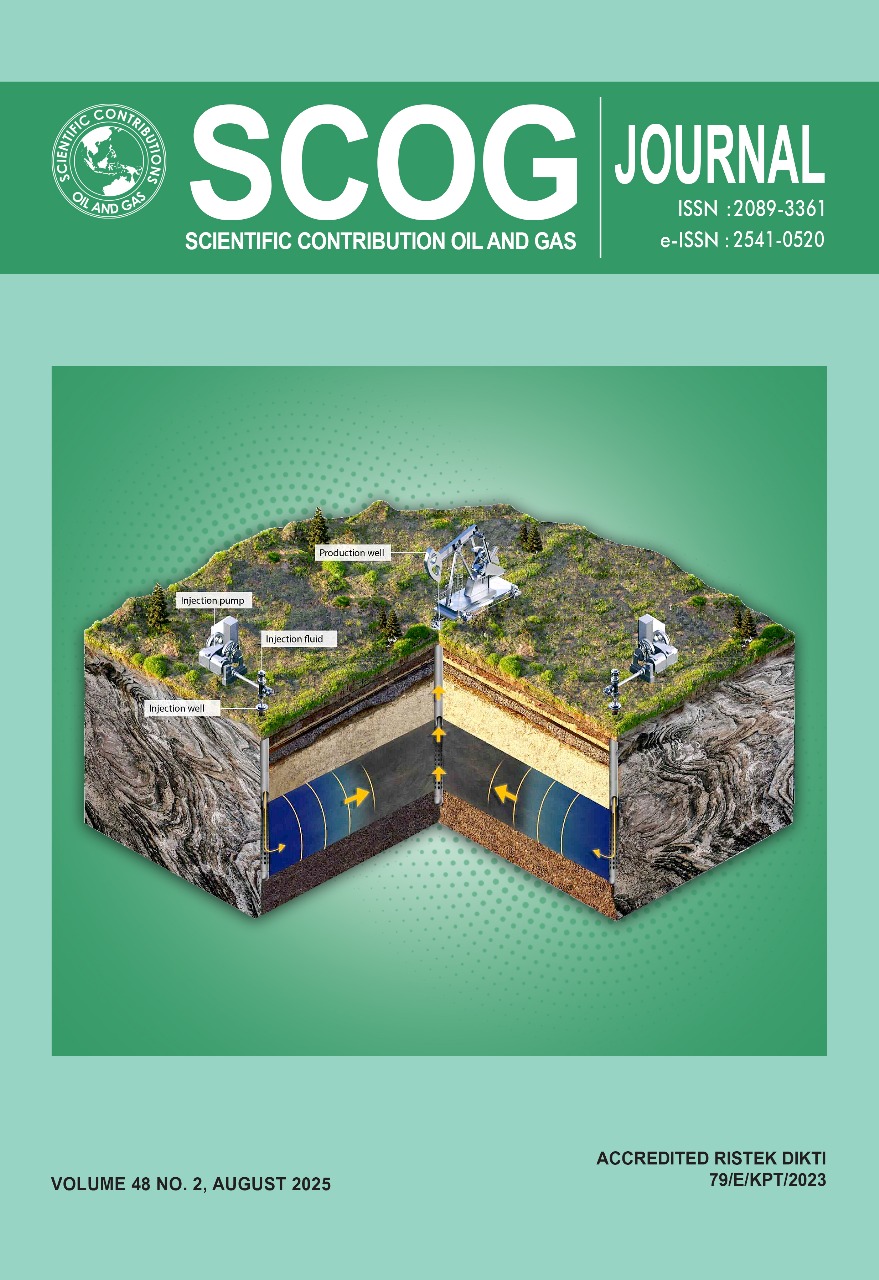
This study evaluates an integrated forecasting framework that combines Capacitance-Resistance Models (CRMP and CRMIP) with ensemble machine learning algorithms (Random Forest and XGBoost) to predict CO₂-Enhanced Oil Recovery performance in the heterogeneous Volve Field. Reservoir simulation was performed using tNavigator with CO₂ injection at 941 tons/day (35 MMSCF/day) over 20 years. The results demonstrate the critical influence of CO₂-specific characteristics, with a determined Minimum Miscibility Pressure of 3299.68 psi and a corresponding oil Swelling Factor of 1.19. Machine learning models, particularly XGBoost, significantly outperformed conventional CRM methods, achieving exceptional accuracy (R² = 0.99-1.00, MAPE = 0.44-2.24%) compared to CRMP/CRMIP (R² = 0.55-0.72, MAPE = 16-23%). The CO₂ injection scenario substantially enhanced oil recovery, achieving a cumulative production of 15.73 MMSTB (RF 20.45%) compared to 9.38 MMSTB (RF 12.19%) for waterflooding, representing a 67.7% improvement and incremental recovery of 6.35 MMSTB. Interwell connectivity analysis revealed dynamic reservoir responses with time constants ranging from 916 to 927 days. The integration of physics-based models with non-linear machine learning algorithms significantly improves prediction accuracy while providing comprehensive insights into reservoir dynamics, allowing for optimal CCUS implementation in heterogeneous reservoir systems.
References
Ahmed, T. (2007). Reservoir Engineering Handbook. In Cardiovascular Imaging (Vol. 27, Issue 7). https://doi.org/10.1016/B978-1-4160-5009-4.50004-2
Alam, M. M. M., Hassan, A., Mahmoud, M., Sibaweihi, N., & Patil, S. (2022). Dual Benefits of Enhanced Oil Recovery and CO2 Sequestration: The Impact of CO2 Injection Approach on Oil Recovery. Frontiers in Energy Research, 10(April), 1–9. https://doi.org/10.3389/fenrg.2022.877212
Arps. (n.d.). Decline_Curve_Analysis.pdf.
Asnawi, M. F., Bisono, H. H., Megantara, M. A., & Kusrini, K. (2024). Aplikasi Prediksi Banjir Menggunakan Algoritma XGBoost Berbasis Website. Journal of Economic, Management, Accounting and Technology, 7(2), 379–389. https://doi.org/10.32500/jematech.v7i2.7644
Chavez-Rodriguez, M. F., Szklo, A., & de Lucena, A. F. P. (2015). Analysis of past and future oil production in Peru under a Hubbert approach. Energy Policy, 77(May 2021), 140–151. https://doi.org/10.1016/j.enpol.2014.11.028
Chicco, D., Warrens, M. J., & Jurman, G. (2021). The coefficient of determination, R-squared, is more informative than SMAPE, MAE, MAPE, MSE, and RMSE in regression analysis evaluation. PeerJ Computer Science, 7, 1–24. https://doi.org/10.7717/PEERJ-CS.623
De Holanda, R. W., Gildin, E., Jensen, J. L., Lake, L. W., & Shah Kabir, C. (2018). A state-of-the-art literature review on capacitance resistance models for reservoir characterization and performance forecasting. Energies, 11(12). https://doi.org/10.3390/en11123368
Du, X., Salasakar, S., & Thakur, G. (2024). A Comprehensive Summary of the Application of Machine Learning Techniques for CO2-Enhanced Oil Recovery Projects. Machine Learning and Knowledge Extraction, 6(2), 917–943. https://doi.org/10.3390/make6020043
Emera, R., & Kalantari Dahaghi, A. (2025). Maximizing conventional oil recovery and carbon mitigation: an artificial intelligence-driven assessment and optimization of carbon dioxide enhanced oil recovery with physics-based dimensionless type curves. Frontiers in Energy Research, 13(March), 1–20. https://doi.org/10.3389/fenrg.2025.1478473
Erfando, T., & Khariszma, R. (2023). Sensitivity Study of the Effect of Polymer Flooding Parameters To Improve Oil Recovery Using X-Gradient Boosting Algorithm. Journal of Applied Engineering and Technological Science, 4(2), 873–884. https://doi.org/10.37385/jaets.v4i2.1871
Fajrul Haqqi, M., Saroji, S., & Prakoso, S. (2023). An implementation of the XGBoost algorithm to estimate effective porosity on well log data. Journal of Physics: Conference Series, 2498(1). https://doi.org/10.1088/1742-6596/2498/1/012011
Fan, D., Lai, S., Sun, H., Yang, Y., Yang, C., Fan, N., & Wang, M. (2025). Review of Machine Learning Methods for Steady State Capacity and Transient Production Forecasting in Oil and Gas Reservoirs. Energies, 18(4), 1–25. https://doi.org/10.3390/en18040842
Fan, Z., Liu, X., Wang, Z., Liu, P., & Wang, Y. (2024). A Novel Ensemble Machine Learning Model for Oil Production Prediction with Two-Stage Data Preprocessing. Processes, 12(3). https://doi.org/10.3390/pr12030587
Fang, P., Zhang, Q., Zhou, C., Yang, Z., Yu, H., Du, M., Chen, X., Song, Y., Wang, S., Gao, Y., Dou, Z., & Cao, M. (2024). Chemical-Assisted CO2 Water-Alternating-Gas Injection for Enhanced Sweep Efficiency in CO2-EOR. Molecules, 29(16), 1–31. https://doi.org/10.3390/molecules29163978
Fu, L., Zhao, L., Chen, S., Xu, A., Ni, J., & Li, X. (2022). A Prediction Method for Development Indexes of Waterflooding Reservoirs Based on Modified Capacitance–Resistance Models. Energies, 15(18). https://doi.org/10.3390/en15186768
Gao, M., Liu, Z., Qian, S., Liu, W., Li, W., Yin, H., & Cao, J. (2023). Machine-Learning-Based Approach to Optimize CO2-WAG Flooding in Low Permeability Oil Reservoirs. Energies, 16(17). https://doi.org/10.3390/en16176149
Gumiere, S. J., Camporese, M., Botto, A., & Lafond, J. A. (2020). Machine Learning vs Physics-Based Modeling for Real-Time Irrigation Management. April. https://doi.org/10.3389/frwa.2020.00008
Hamadi, M., Mehadji, T. El, Laalam, A., Zeraibi, N., Tomomewo, O. S., Ouadi, H., & Dehdouh, A. (2023). Prediction of Key Parameters in the Design of CO 2 Miscible Injection via the Application of Machine Learning Algorithms. 1905–1932. https://doi.org/https://doi.org/10.3390/ eng4030108
Hidayat, F., & Astsauri, T. M. S. (2021). Applied random forest for parameter sensitivity of low-salinity water injection (LSWI). https://doi.org/10.1016/j.aej.2021.06.096
Jiashun Luo. (2022). Effect of Reservoir Heterogeneity on CO2 Flooding in Tight Oil Reservoirs. https://doi.org/10.3390/en15093015
Khanal, A. (2022). Physics-Based Proxy Modeling of CO 2 Sequestration in Deep Saline Aquifers. https://doi.org/https://doi.org/10.3390/en15124350
Khurshid, I., & Afgan, I. (2021). Geochemical investigation of CO2 injection in oil and gas reservoirs of the Middle East to estimate the formation damage and related oil recovery. Energies, 14(22). https://doi.org/10.3390/en14227676
Kristanto, D., Hariyadi, Pramudiohadi, E. W., Kurniawan, A., Nursidik, U. S., Asmorowati, D., Widiyaningsih, I., & Cahyaningtyas, N. (2025). Optimization of CO2 Injection Through Cyclic Huff and Puff to Improve Oil Recovery. Scientific Contributions Oil and Gas, 48(2), 53–67. https://doi.org/10.29017/scog.v48i2.1659
Lee, H. S., Cho, J. H., Lee, Y. W., & Lee, K. S. (2021). Compositional modeling of impure CO2 injection for enhanced oil recovery and CO2 storage. Applied Sciences (Switzerland), 11(17). https://doi.org/10.3390/app11177907
Lee, S., Bae, W., Permadi, A. K., & Park, C. (2023). Hydraulic Stimulation of Enhanced Geothermal System: A Case Study at Patuha Geothermal Field, Indonesia. International Journal of Energy Research, 2023. https://doi.org/10.1155/2023/9220337
Li, H., Gong, C., Liu, S., & Xu, J. (2022). Applied Sciences Machine Learning-Assisted Prediction of Oil Production and CO 2 Storage Effect in CO 2 -Water-Alternating-Gas Injection ( CO 2 -WAG ). https://doi.org/https:// doi.org/10.3390/app122110958
Makhotin, I., & Orlov, D. (2022). Machine Learning to Rate and Predict the Efficiency of Waterflooding for Oil Production. https://doi.org/https:// doi.org/10.3390/en15031199
Moreno, G. A., & Lake, L. W. (2014). Input signal design to estimate interwell connectivities in mature fields from the capacitance-resistance model. Petroleum Science, 11(4), 563–568. https://doi.org/10.1007/s12182-014-0372-z
Núñez-lópez, V., & Moskal, E. (2019). Potential of CO 2 -EOR for Near-Term Decarbonization. 1(September). https://doi.org/10.3389/fclim.2019.00005
Orin, T. Z., Rahman, M. T., Islam, M. A., Alam, K. M. H., Mannafi, A. S. M., & Habib, K. (2025). Enhanced Oil Recovery through Carbon dioxide Injection: A Compositional Simulation Approach. Journal of Advanced Research in Applied Sciences and Engineering Technology, 49(1), 149–160. https://doi.org/10.37934/araset.49.1.149160
Qiao, M., & Zhang, F. (2025). Rheological Properties of Crude Oil and Produced Emulsion from CO 2 Flooding. https://doi.org/10.3390/en18030739
Ramadhan, R., Novriansyah, A., Erfando, T., Tangparitkul, S., Daniati, A., Permadi, A. K., & Abdurrahman, M. (2023). Heterogeneity Effect on Polymer Injection: a Study of Sumatra Light Oil. Scientific Contributions Oil and Gas, 46(1), 39–52. https://doi.org/10.29017/SCOG.46.1.1334
Rhamadhani, D. A., Saputri, E. E. D., & Sari, R. L. (2023). Forecasting Oil Production of Well 159-F-14H in the Volve Field Using a Machine Learning Model. Indonesian Journal of Artificial Intelligence and Data Mining, 7(1), 86. https://doi.org/10.24014/ijaidm.v7i1.24907
Salehian, M., & Çınar, M. (2019). Reservoir characterization using dynamic capacitance–resistance model with application to shut-in and horizontal wells. Journal of Petroleum Exploration and Production Technology, 9(4), 2811–2830. https://doi.org/10.1007/s13202-019-0655-4
Saraiva, T. A., Szklo, A., Lucena, A. F. P., & Chavez-Rodriguez, M. F. (2014). Forecasting Brazil’s crude oil production using a multi-Hubbert model variant. Fuel, 115(2014), 24–31. https://doi.org/10.1016/j.fuel.2013.07.006
Shabani, A., Moosavi, M. S., Zivar, D., & Jahangiri, H. R. (2020). Data-driven technique for analyzing the injector efficiency in a waterflooding operation. Simulation, 96(8), 701–710. https://doi.org/10.1177/0037549720923386
Shafiei, M., Kazemzadeh, Y., Escrochi, M., Cortés, F. B., Franco, C. A., & Riazi, M. (2024). OPEN A comprehensive review of direct methods to overcome the limitations of gas injection during the EOR process. Scientific Reports, 1–29. https://doi.org/10.1038/s41598-024-58217-1
Sheng, S., Duan, Y., Wei, M., Yue, T., Wu, Z., & Tan, L. (2021). Analysis of Interwell Connectivity of Tracer Monitoring in Carbonate Fracture-Vuggy Reservoir: Taking T-Well Group of Tahe Oilfield as an Example. Geofluids, 2021. https://doi.org/10.1155/2021/5572902
Sugihardjo, O. (2009). Perubahan Sifat-Sifat Fluida Reservoir pada Injeksi CO 2. 43(1), 11–16. https://doi.org/https://doi.org/10.29017/LPMGB.43.1.122
Telmadarreie, A., & Trivedi, J. J. (2020). CO2 foam and CO2 polymer-enhanced foam for heavy oil recovery and CO2 storage. Energies, 13(21), 1–15. https://doi.org/10.3390/en13215735
Wang, D., Li, Y., Zhang, J., Wei, C., Jiao, Y., & Wang, Q. (2019). Improved CRM model for inter-well connectivity estimation and production optimization: Case study for karst reservoirs. Energies, 12(5). https://doi.org/10.3390/en12050816
Wang, W., Yao, J., Li, Y., & Lv, A. (2017). Research on carbonate reservoir interwell connectivity based on a modified diffusivity filter model. Open Physics, 15(1), 306–312. https://doi.org/10.1515/phys-2017-0034
Wei, J., Yan, Y., Chen, Y. J., Gao, M., Lv, W., Yu, H., Gao, Y., Chen, X., Tan, K., & Guan, Y. (2025). Experimental Study on the Sweep Patterns of CO2 Flooding in Reservoirs with Interlayer Heterogeneity. ACS Omega, 10(14), 14121–14137. https://doi.org/10.1021/acsomega.4c11327
Xie, Z., Feng, Q., Zhang, J., Shao, X., Zhang, X., & Wang, Z. (2021). Prediction of conformance control performance for cyclic-steam-stimulated horizontal well using the XGBoost: A case study in the Chunfeng heavy oil reservoir. Energies, 14(23). https://doi.org/10.3390/en14238161
Ye, H., Deng, J., Ma, J., Zhang, K., Li, Y., Zhang, H., & Zhong, K. (2025). Interwell Connectivity Analysis Method Based on Injection–Production Data Time and Space Scale Coupling. Processes, 13(2), 1–13. https://doi.org/10.3390/pr13020373
Downloads
Published
Issue
Section
License
Copyright (c) 2025 © Copyright by Authors. Published by LEMIGAS

This work is licensed under a Creative Commons Attribution 4.0 International License.