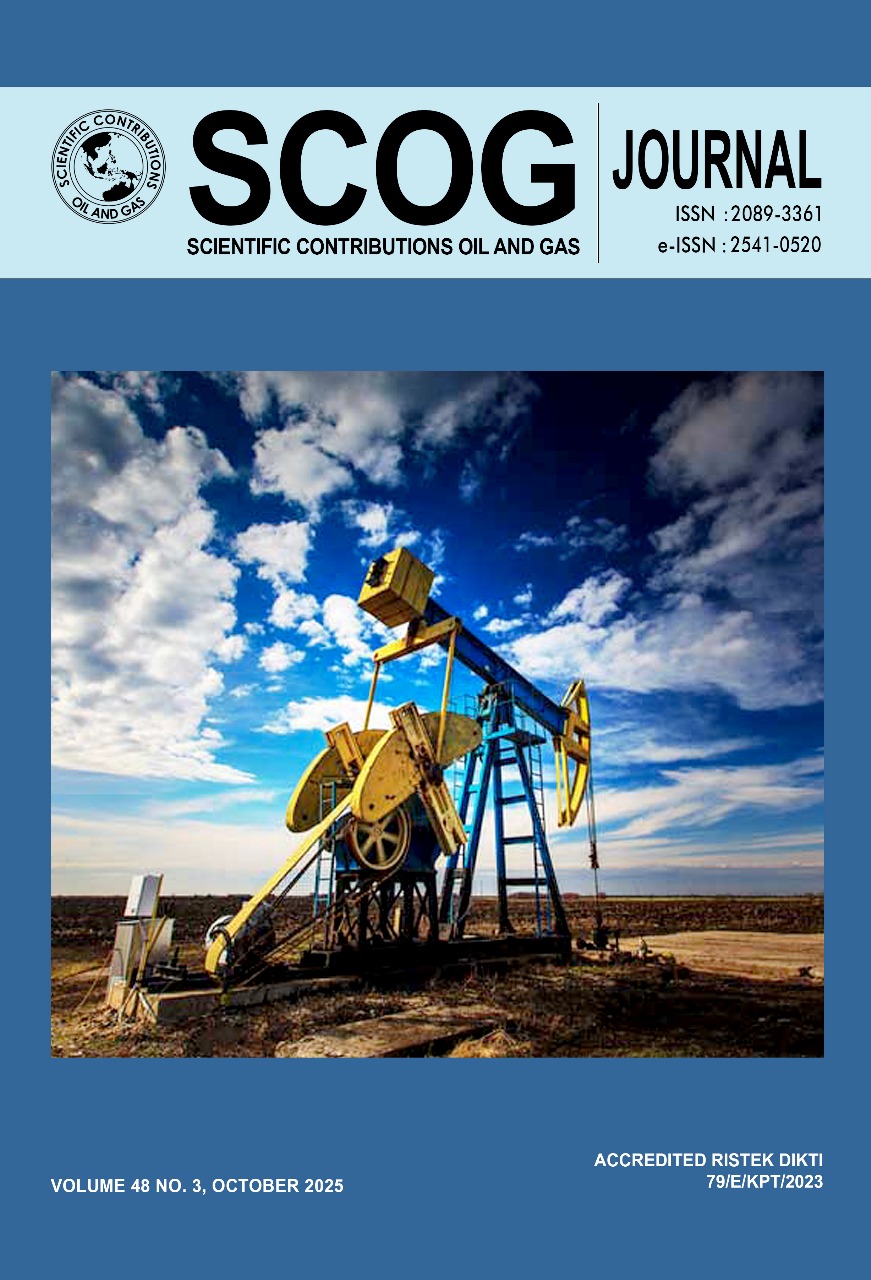
Reduction of Carbon Emission in East Java Power Generation Sector Through The Use of Saline Aquifer as CO2 Storage - A Conceptual Study
DOI:
https://doi.org/10.29017/scog.v48i3.1926Keywords:
CO2 emissions, carbon capture and storage (CCS), East Java, Tanjung Awar-awar power plant, saline aquifer, Kujung Formation, CO2 injection wellsAbstract
East Java region, as one of the most industrialized regions in Indonesia, is a significant contributor to national greenhouse gas (GHG) emissions, and therefore may play a significant role in supporting the national commitment to reach net zero emissions (NZE). This study is made to provide an example of how a conceptual CCS scheme using a saline aquifer is applied in the region. Tanjung Awar-awar coal-fired power plant, which is located in the Tuban city area on the northern coast of East Java, is selected as the GHG source. With its power generation capacity of 2 x 350 MW, it emits 4.5 Mt CO2e annually. The extensively distributed Kujung carbonate formation is chosen as the CO2 saline aquifer storage. Amidst the typical data rarity commonly faced in preliminary studies on saline aquifers, modeling for CO2 storage has been performed using all available primary and secondary data from all available sources. The most likely estimate of storage resource shows 479 Mt CO2e (status: 3U in SRMS classification system), with its A2 block possessing 162.78 MtCO2 storage resource. The CO2 injection scheme is essentially a volumetric balancing between CO2 emissions and injection rates through injection wells. Well injection capacities are estimated, and must be able to cope with CO2 emissions from the power plant. Accordingly, two CCS scenarios of 50% CO2 capture (Scenario A; 4,671 tons/day) and 100% CO2 capture (Scenario B; 9,342 tons/day) are set. To serve the two scenarios, four (4) and eight (8) horizontal wells are needed, respectively. A similar approach has also been made for vertical injection wells. Following the assumptions set in the CCS scheme, a total of 34,098,300 tons and 68,189,300 tons of CO2 can be stored in a 20-year injection permit for Scenario A and Scenario B, respectively. Nonetheless, these figures constitute just fairly small fractions of the Kujung A2 block’s storage resource. This shows the huge potential of the Kujung Formation to act as a saline aquifer storage for CCS schemes in the East Java region. This also presents the potential of the Kujung Formation to sustain multi-CO2 sources and prolonged injection schemes. Despite many challenges faced, especially in relation to data scarcity, the results may serve as a reference for more detailed project-based studies in the future.
References
Abdurrahman, M., Bae, W., & Kim, S. 2015. CO2 Sources and Future EOR Prospects In Sumatra Island-Indonesia. The 2015 World Congress on Advances in Civil, Environmental, and Material Research (ACEM15), Incheon – Korea, August 25-29 2015.
ADB, 2013. ADB Annual Report. Asian Development Bank. DOI: 10.1007/978-1-349-59541-9_92
Ahmed, T. & McKinney, P.D. 2005. Advanced Reservoir Engineering. Gulf Professional Publishing, 200 Wheeler Road, Burlington MA01803 – USA. ISBN: 0-7506-7733-3.
Azmi, R., Maslahat, P., & Wahono, J.W. 2022. The carbon footprint from the power plant in Indonesia and renewable energy supply for reduce the carbon emission. The 1st ASEAN International Conference on Energy and Environment, IOP Conf. Series: Earth and Environmental Science 997 (2022) 012008. DOI: 10.1088/1755-1315/997/1/012008.
Bachu, S., Bonijoly, D., Bradshaw, J., Burruss, R., Holloway, S., Christensen, N.P., and Mathiassen, O.M., 2007, CO2 storage capacity estimation—Methodology and gaps: International Journal of Greenhouse Gas. DOI: 10.1016/S1750-5836(07)00086-2.
Bokka, H.K. & Lau, H.C. 2023. Decarbonizing Borneo's power and industry sectors by carbon capture and storage. Geoenergy Science and Engineering 226 (September 2022), 211796. DOI: 10.1016/j.geoen.2023.211796
Bungsu, S., Primasari, I., Purba, I.F., & Aliefan, T.A. 2018. CO2 Injection By Huff & Puff At Jatibarang Field. Association of Indonesian Petroleum Engineers (IATMI) Symposium, held in Padang 1-3 October 2018.
CSLF 2008. Comparison between Methodologies Recommended for Estimation of CO2 Storage Capacity in Geological Media. Report by the Carbon Sequestration Leadership Forum (CSLF) on CO2 Storage Capacity Estimation, Phase III.
Dewanto, A., Anderson, G., Singh, P., Silitonga, F. & Maulana, A. 2022. A Comprehensive Ensemble Modelling Study To Evaluate Subsurface Uncertainties Associated With Tangguh CO2 Enhanced Gas Recovery (EGR) Project To Deliver A Robust And Quality-Optimized Development Plan. Proceedings, Indonesian Petroleum Association (IPA) Forty-Sixth Annual Convention & Exhibition, September 2022.
Finkenrath, M., J. Smith and D. Volk (2012), "CCS Retrofit: Analysis of the Globally Installed Coal-Fired Power Plant Fleet", IEA Energy Papers, No. 2012/07, OECD Publishing, Paris. DOI: 10.1787/5k9crztg40g1-en
Goodman, A., Hakala. A., Bromhal, G., Deel, D., Rodosta, T., Frailey, S., Small, M., Allen, D., Romanov, V., Fazio, J., Huerta, N., McIntyre, D., Kutchko, and Guthri, G. 2011 U.S. DOE methodology for the development of geologic storage potential for carbon dioxide at the national and regional scale, International Journal of Greenhouse Gas Control Volume 5, Issue 4, July 2011, Pages 952-965. DOI: 10.1016/j.ijggc.2011.03.010.
Goodman, A., Sanguinito, S., and Levine, J.S. 2016 Prospective CO2 Saline Resource Estimation Methodology: Refinement of Existing US-DOE-NETL Methods Based on Data Availability, United States Department of Energy, National Energy Technology Laboratory, P.O. Box 10940, Pittsburgh, Pennsylvania 15236. International Journal of Greenhouse Gas Control. DOI: 10.1016/j.ijggc.2016.09.009.
Gorecki, C.D., Sorensen, J.A., Bremer, J.M., Knudsen, D.J., Smith, S.A., Steadman, E.A., and Harju, J.A. 2009. Development of Storage Coefficient for Determining the Effective CO2 Storage Resource In Deep Saline Formations. SPE 12644, presented at The SPE International Conference of CO2 Capture, Storage, and Utilization, held in San Diego – California 2 – 4 November 2009. DOI: 10.2118/126444-MS.
Gunter, W.D., Perkins, E.H. and Hutcheon, I. 2000. Aquifer disposal of acid gases: modelling of water-rock reactions for trapping of acid wastes. Applied Geochemistry, Vol. 15, Issue 8, September, pp: 1085 – 1095. DOI: 10.1016/S0883-2927(99)00111-0
Hamilton, W. 1989. Convergent -Plate Tectonics Viewed From The Indonesian Region. Branch of Geophysics, United States Geological Survey, Denver, Colorado, 80225, U.S.A. DOI: 10.1007/978-94-009-2253-2_27.
Iskandar, U.P., Usman, and Sudarman, S., 2013. Ranking of Indonesia sedimentary basin and storage capacity estimates for CO2 geological storage, Energy Procedia, 37 (2013), 5172-5180. Lau, H.C. 2023. The Contribution of Carbon Capture and Storage to the Decarbonization of Coal-Fired Power Plants in Selected Asian Countries. Energy Fuel, DOI: 10.1021/acs.energyfuels.3c02648
LEMIGAS 2004. Seismo-paleogeography and seismic facies of Wonocolo, Ngrayong, and Kujung Formations, Rembang-Randublatung Zones Northeast Java Basin. (in Bahasa Indonesia), Study report prepared by LEMIGAS for Directorate of Upstream Oil and Gas Business PT Pertamina. Unpublished Report.
Marbun, B.T.H., Sinaga, S.Z., Purbantanu, B., Santoso, D., Kadir, W.G.A., Sule, R., Prasetyo, D.E., Prabowo, H., Susilo, D., Firmansyah, F.R., Palilu, J.M., Saprudin, W., Andhika, B., 2023. Lesson learned from the assessment of planned converted CO2 injection well integrity in Indonesia e CCUS project. Heliyon 9 (8), e18505. DOI: 10.1016/j.heliyon.2023.e18505.
Michael, K., Golab, A., Shulakova, V., Ennis-King, J., Allinson, G., Sharma, S., and Aiken, T. 2010. Geological storage of CO2 in saline aquifers—A review of the experience from existing storage operations. International Journal of Greenhouse Gas Control 4 (2010) 659–667, DOI: 10.1016/j.ijggc.2009.12.011.
Ministry of Energy and Mineral Resources (MEMR) 2022. Sedimentary Basin Map of Indonesia. Prepared by the Geological Agency of Ministry of Energy and Mineral Resources – The Republic of indonesia.
Ministry of Energy and Mineral Resources (MESDM) 2023a. Procedures for implementing the carbon economic value of the electricity generation subsector. Ministerial Regulation.
Ministry of Energy and Mineral Resources (MESDM) 2023b. Study on Indonesia’s national CO2 Storage Resources. A study report by the Center for Oil and Gas Testing “LEMIGAS” under the Directorate General of Oil and Gas – MESDM of The Republic of Indonesia.
Ministry of Energy and Mineral Resources (MESDM) 2023c. Implementation of Carbon Capture, Utilization and Storage in Upstream Oil and Gas Business Activities. Ministerial Regulation.
Mudjiono, R. (2018). Exploration of the North Madura Platform, Offshore East Java, Indonesia. 1, 707–726, DOI: 10.29118/ipa.980.707.
Mulyasari, F., Harahap, A.K., Rio, A.O., Sule, R., & Kadir, W.G.A. (2021). Potentials of the public engagement strategy for public acceptance and social license to operate: Case study of Carbon Capture, Utilisation, and Storage Gundih Pilot Project in Indonesia. International Journal of Greenhouse Gas Control 108 (2021) 103312. DOI: 10.1016/ j.ijggc.2021.103312.
Openinframap 2024. Indonesia Power Plants. https://openinframap.org/stats/area/Indonesia/plants.
Othman, M.R., Martunus, Zakaria, R. & Fernando, W.J.N. 2009. Strategic planning on carbon capture from coal fired plants in Malaysia and Indonesia: A review. Energy Policy 37 (2009) 1718–1735. DOI: 10.1016/j.enpol.2008.12.034.
Panggabean, Y.B., Pramadewi, T.B., Kusuma, E.A., Maryanto, A. 2022. Designing CO2-EOR in Indonesia by Matching Business Strategy: Study Case East Java Field, Indonesia. Paper presented at the SPE EuropEC - Europe Energy Conference featured at the 83rd EAGE Annual Conference & Exhibition, Madrid, Spain, June 2022. Paper Number: SPE-209704-MS, DOI: 10.2118/209704-MS.
Presidential Regulation 2021. Peraturan Presiden Republik Indonesia Nomor 98 Tahun 2021 tentang Penyelenggaraan Nilai Ekonomi Karbon Untuk Pencapaian Target Kontribusi Yang Ditetapkan Secara Nasional Dan Pengendalian Emisi Gas Rumah Kaca Dalam Pembangunan Nasional. Issued on 29 october 2021, Minister of Law and Human Right of The Republic of Indonesia.
Ramadhan, R., Mon, M.T., Tangparitkul, S., Tansuchat, R., Agustin, D.A. (2024). Carbon capture, utilization, and storage in Indonesia: An update on storage capacity, current status, economic viability, and policy. Energy Geoscience 5 (2024) 100335. DOI: 10.1016/j.engeos.2024.100335.
Satyana, A. H., Erwanto, E., & Prasetyadi, C. (2004). Rembang-Madura-Kangean-Sakala (RMKS) Fault Zone, East Java Basin: The Origin and Nature of a Geologic Border. Indonesian Association Of Geologists 33rd Annual Convention, December, 1–23.
Sharaf, E., Simo, J. A., Carroll, A. R., & Shields, M. (2005). Stratigraphic evolution of Oligocene-Miocene carbonates and siliciclastics, East Java basin, Indonesia. American Association of Petroleum Geologists Bulletin, 89(6), 799–819, DOI: 10.1306/01040504054
SPE 2017. CO2 Storage Resources Management System. Co-sponsored by AAPG, SEG, SPEE, WPC, SPWLA, and EAGE. https://www.spe.org/industry/docs/SRMS.pdf.
Sugihardjo, 2021, Penyaringan dan Peringkat Cekungan Kalimantan Timur serta Potensinya untuk Implementasi CCUS, Lembaran Publikasi Minyak dan Gas Bumi, Vol. 55 No. 3, Desember 2021: 171 – 185. DOI: DOI:10.29017/LPMGB.55.3.706
Sugihardjo, Usman, Tobing E.M.L., 2012. Preliminary Carbon Utilization and Storage Screening of Oil Fields in South Sumatra Basin, Scientific Contributions Oil & Gas, Volume 35, Number 2, September 2012. ISSN: 2089-3361. LEMIGAS Research and Development Center for Oil and Gas Technology. DOI: 10.29017/SCOG.35.2.778
Susantoro, T.M., Sugihardjo, Wikantika, K., Sunarjanto, D., Pasarai, U., Widarsono, B., Rahmadi, A., Romli, M., Wahyudi, P., & Kepies, S. 2023. CCUS-EOR Optimization to Achieve Zero Emission Program Targets in Northwest Java Basin. EVERGREEN Joint Journal of Novel Carbon Resource Sciences & Green Asia Strategy, Vol. 10, Issue 03, pp1809-1818, September 2023, DOI: 10.5109/7151730.
Umar, D.F., Zulfahmi, Mardiutomo, N., Monika, I., Setiawan, L., Wijaya, T., Daranin, E.A., & Gunawan. (2024). Low-rank coal upgrading to optimize its utilization as fuel. IOP Conf. Series: Earth and Environmental Science 1378 (2024) 012031, DOI:10.1088/1755-1315/1378/1/012031.
U.S. Department of Energy and the National Energy Technology Laboratory (US DOE – NETL), 2008. Carbon Sequestration Atlas of the United States and Canada, Second Edition.
U.S. Department of Energy (US DOE), 2010. Carbon Sequestration Atlas of the United States and Canada, Third Edition. Available on line at https://www.osti.gov/servlets/purl/1814019.
Wang, F., Jing, J., Yang, Y., Liu, H., Sun, Z., Xu, T., and Tian, H. 2016. Impacts of injection pressure of a dip-angle sloping strata reservoir with low porosity and permeability on CO2 injection amount. Greenhouse Gas Sci Technol. 00:1–14 (2016); DOI: 10.1002/ghg
Weisel, J. 2009. Retrofitting CO2 Capture. EPRI Journal summer 2009. http://mydocs.epri.com/docs/CorporateDocuments/EPRI_Journal/2009
Wibowo, A., 2020. CCUS Activities in Indonesia. Japan - Asia CCUS Forum 2020.
Zhang, K. & Lau, H.C. 2022. Regional opportunities for CO2 capture and storage in Southeast Asia. International Journal of Greenhouse Gas Control Vol. 116, May 2022, 103628. DOI: 10.1016/j.ijggc.2022.103628.
Zhou, Q., Birkholzer, J.T., Tsang, C-F., Rutqvist, J. 2008. A method for quick assessment of CO2 storage capacity in closed and semi-closed saline formations. International Journal of greenhouse gas control 2 (2008) 626–639. DOI:10.1016/j.ijggc.2008.02.004.
Downloads
Published
Issue
Section
License
Copyright (c) 2025 © Copyright by Authors. Published by LEMIGAS

This work is licensed under a Creative Commons Attribution 4.0 International License.